
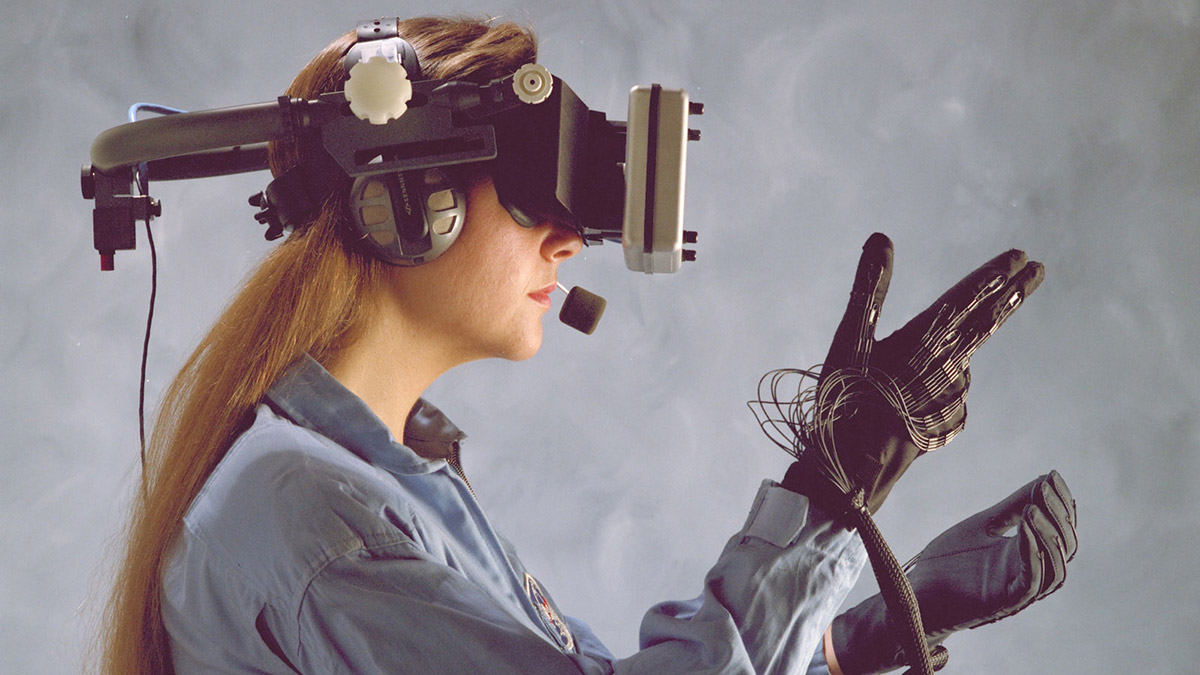
The rapid development of technology has left the world in awe, and it’d be interesting to see how it’s affecting the world. While it provides immense benefits, I think it can also be harmful. The debate over whether the technology is inherently good or bad is complex, but one undeniable shift is the human community’s increasing reliance on screens. It seems like we are more controlled by technology than the other way around. Virtual Reality (VR) and Augmented Reality (AR) play a significant role in this shift allowing us to immerse ourselves in a delusory world, creating an escape from the real world. To understand it better, let’s take a closer look at AR and VR.
1. What are AUGMENTED REALITY and VIRTUAL REALITY?
Augmented Reality is about combining the digital world with the real elements. It’s about reflecting the digital elements into the real world. It is suitable for mobile devices and laptops. Best example for AR is a snap bunny filter or a dog filter. Or getting an AR view of a Pizza online before ordering. But the technical revolution doesn’t end here, try playing Pokémon using AR and you’ll know it.
Whereas, VR is a computer generated simulation that provides a 3D-4D space that provides a feel of a realistic world. It is like getting into a virtual world that doesn’t exist in reality. Once getting inside this environment you can explore and interact with everything inside. The best example for VR are car racing games. Offering entertainment, infotainment, and educational ways of learning, are the best part of these innovations.
2. Exploring The Origins:
The inception of virtual reality can be traced back to Charles’s Wheatstone creation of the stereoscope, making an initial association with immersive technology. Stereoscope is an optical system with two distinct images on left and right, typically showing the same image but from two different angles. This simulates the natural process of perception of the same image from the right eye and left eye, creating a three dimensional image. In 1968, Harvard Professor Ivan Sutherland and his student Bob Sproull pioneered the first AR-VR helmet , known as “The Sword of Damocles.” Since then the continuous evolution has created a next level demand of the non-real world. Prediction by statistica said that, It was expected that the world-wide market size for AR and VR is about to reach $297 billion by the year of 2024, increased by 10 times that of the market size of $30.7 billion in 2021. AR and VR are the transforming industries with help of software and hardware developers, graphic designers, researchers
3. Technology Behind AR and VR
Augmented Reality :
SLAM (Simultaneous Localization and Mapping) is a complex algorithm that acts as the brain of AR. SLAM builds a 3D map of the surroundings With the help of the technologies like marker-based tracking that uses the predefined visual patterns to identify the object and later process the image and the algorithm to recognize shape, texture etc. Moreover, LiDAR sensor provides the depth information allowing virtual objects to be placed behind, in front objects convincingly.
To enhance the experience, AR devices like smartphones, tablets and headsets that overlay the virtual content onto the real world. The advanced rendering techniques ensure realistic lighting, shadows, reflections giving a smooth blending. The facility of touchscreens, hand gestures, voice commands and even eye tracking makes it interactive and appealing.
Virtual Reality:
Head-Mounted Displays (HMD) are a portal to the virtual world. HMDs house two high-resolution screens, one for each eye, that display slightly different perspectives to create a 3D image. Lenses further enhance the illusion by focusing the light and making the virtual world seem larger than life.
Thus VR systems use a combination of sensors like gyroscopes, accelerometers, and magnetometers to track your head movements and rotations. Some even have external cameras that map your surroundings, allowing you to walk around and interact with virtual objects in a more natural way. But all the data needs crunching! It requires powerful processors and graphic cards to render complex 3D worlds. The magic truly comes alive with the software content and VR controller comes together. The experience has endless possibilities that can take you from scaling mountains to meeting aliens.
4. Applications in Various Industries:
AR and VR offer immersive experiences with popular titles like “Beat Saber” and “Superhot VR”. Augmented Reality enhances entertainment through apps like Pokémon Go, Snapchat and Instagram filters. Moving into training and education, industries like aviation, healthcare, and military use VR for realistic simulations while AR apps engage students in interactive learning experiences. In healthcare, VR aids in medical training and surgery simulations, while AR provides real-time information for surgeons. Architects and designers utilize VR to create 3D models while AR allows users to visualize furniture in their homes.
5. Conclusion:
In conclusion, while Augmented Reality (AR) and Virtual Reality (VR) undeniably offer unprecedented benefits, their widespread adoption has led to an increasing dependency on the technological devices. The surge in usage has resulted in these devices exerting a substantial influence over the human mind. The attraction has isolated mankind into the unrealistic world, where they have started to lose the connection with the physical world and nature. It becomes imperative to approach these technologies mindfully. When used judiciously, AR and VR have the potential to be significant boons, going beyond the limits in the field of education, entertainment and more. However, if unchecked, the pervasive influence of these technologies may transform them into potential banes, diminishing our autonomy and altering the fabric of human interaction that may lead to issues like depression and anxiety in the long run. Striking a balance between harnessing the power of AR and VR along with preserving our independence is crucial to put a boundary between the virtual and real world before it gets blurred.
Comments are closed.